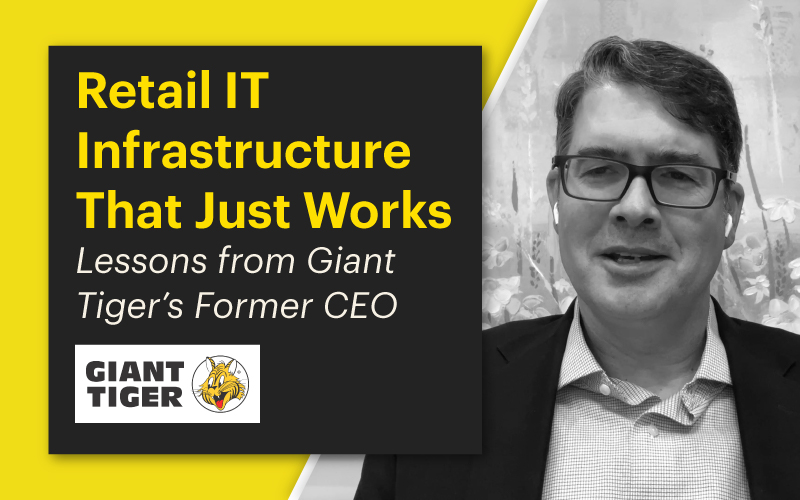
Retail IT has never been more mission-critical, and it’s never been more complex. In a recent PodMagic episode, Bruce Kornfeld from StorMagic sat down with Paul Wood, former CEO of Giant Tiger, to talk about the realities of retail technology leadership.

Paul helped Giant Tiger grow from 100 to more than 250 stores across Canada. That kind of expansion brought big infrastructure demands, tough budget choices, and constant pressure to keep stores running smoothly. His key takeaway? IT should support operations without getting in the way.
In this blog, we’re sharing Paul’s most valuable lessons, with practical takeaways for IT leaders navigating today’s fast-changing retail landscape. Whether you manage 20 stores or 20,000, these insights will help future-proof your retail IT infrastructure strategy.
Simple Retail IT Infrastructure Wins Every Time
Paul made a strong point about simplicity beating sophistication. Big platforms with endless features may sound impressive, but most retailers don’t need that complexity and can’t afford it. What they need is technology that works, doesn’t demand a team of specialists, and fits seamlessly into day-to-day operations.
Simplicity is about being strategic, not basic. At Giant Tiger, this meant choosing systems that store staff could use confidently, without constant IT intervention. When infrastructure is easy to manage, it scales faster, costs less, and performs better under pressure.
The StorMagic hyperconverged infrastructure follows the same philosophy. It’s lightweight, intuitive, and purpose-built for edge environments like retail stores. It cuts out the noise and delivers exactly what your business needs to stay competitive, nothing more and nothing less.
Smart Budgeting Starts with Smarter Infrastructure
One of the more candid parts of the interview was Paul’s breakdown of CapEx versus OpEx pressures in retail IT infrastructure planning. It is not just about getting the best deal or finding the lowest-cost solution. It is about finding retail IT infrastructure that aligns with the business’s financial model, whether that means upfront investments or flexible, ongoing expenses.
In retail, every dollar counts. IT leaders are often tasked with doing more with less, especially in lean environments where resources are stretched. The challenge is to invest in technology that delivers high availability and performance without locking you into bloated contracts or overspending on unused features.
StorMagic offers the kind of cost-effective agility that makes both finance teams and operations leaders happy. Whether you are looking to minimize CapEx with subscription-based models or optimize OpEx with low-maintenance deployments, the right infrastructure gives you choices. That flexibility is what drives smarter IT decisions.
Why Going Small Can Mean Thinking Bigger
Paul’s leadership experience included evaluating major IT vendors, from the household names to the niche players. His advice to retail CIOs and IT leaders was clear: do not just assume that bigger is better. Large vendors may bring brand recognition, but they also bring complexity, slower support cycles, and solutions that are not always tailored to your specific needs.
Smaller vendors, like StorMagic, often offer greater flexibility, deeper customer support, and a product roadmap that is more responsive to customer needs. In distributed retail, where every site has its own challenges and timelines are tight, that agility can make all the difference.
Choosing a technology partner should feel like building a relationship, not signing a one-size-fits-all agreement. Paul’s message reinforces that vendors who truly understand the retail space and offer personalized solutions create more value in the long run than legacy providers who treat every customer the same.
IT Needs to Scale with the Business, Not Just Support It
Giant Tiger’s growth from 100 to 250 stores didn’t just require more of the same IT. It required rethinking how infrastructure was deployed, supported, and scaled. The turning point came when their retail IT infrastructure started aligning with business goals, not just keeping the lights on.
That meant making infrastructure decisions flexible enough to evolve with the business. It meant bringing new stores online quickly, keeping remote support simple, and ensuring staff weren’t slowed down by unreliable systems.
At StorMagic, we believe IT shouldn’t just react to growth; it should enable it. From fast deployments to simplified management and built-in edge resilience, our solutions help retail IT teams lead with confidence.
Ready to Rethink Your Retail IT Strategy?
If you’re a retail IT leader, a business executive responsible for store performance, or a tech partner supporting distributed environments, this episode is a must-listen. Paul Wood brings real-world wisdom from the front lines of retail expansion, and Bruce Kornfeld connects the dots with practical tech strategies.
Want more insights like these? Catch the full PodMagic episode and subscribe for future interviews with retail, IT, and edge computing leaders.
Or explore how StorMagic supports modern retail with cost-effective, reliable edge IT solutions.